
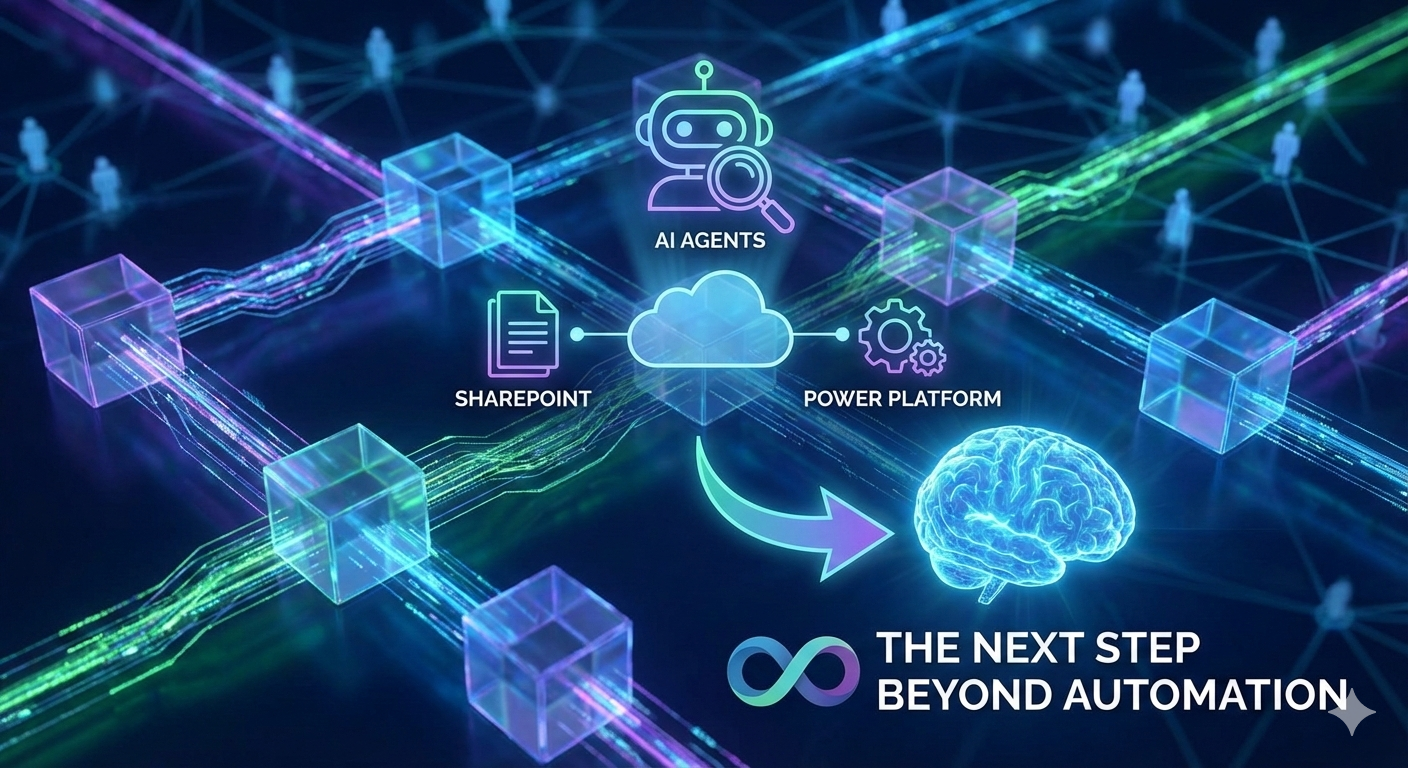
For years, automation has been the gold standard for digital transformation. Tools like Power Automate have enabled businesses to streamline processes efficiently. However, today’s organizations need more than just speed—they need intelligence. AI agents in SharePoint and Power Apps are redefining how systems operate by enabling them to understand context, make decisions, and take action proactively.
From Automation to Intelligent Action
Traditional automation works on fixed logic: when this happens, do that. It’s efficient, but rigid. The moment a process becomes complex—multiple data sources, exceptions, or judgment-based decisions—automation starts to fall short.
AI agents change that equation.
An AI agent can observe data across SharePoint, Power Apps, Power Automate, emails, and business systems. It understands patterns, reads content, evaluates conditions, and then decides what action to take. Instead of waiting for a predefined trigger, it actively monitors and responds.
In simple terms, automation executes instructions.
AI agents interpret situations.
How AI Agents Work with SharePoint and Power Apps
Modern SharePoint is no longer just a content repository. With AI layered in, it becomes a living knowledge hub. Documents, lists, pages, and metadata provide rich context—and AI agents thrive on context.
Imagine an AI agent embedded across SharePoint and Power Apps that:
- Reads incoming documents stored in SharePoint
- Understands their intent and priority
- Updates or creates records through Power Apps
- Initiates or modifies workflows in Power Automate
- Notifies the right stakeholders—or resolves issues autonomously
This is not hypothetical. It’s already happening.
For example, instead of a manual approval workflow, an AI agent can review historical approvals, assess risk, analyze content, and decide whether an item even needs human review. Low-risk items move forward automatically, while exceptions are escalated intelligently.
Power Automate: From Workflow Engine to Action Layer
Power Automate has always been excellent at execution. What AI agents bring is decision-making intelligence before execution.
An AI agent might:
- Detect a delay in a business process
- Analyze why it’s happening using SharePoint data and logs
- Choose the most appropriate workflow
- Adjust steps dynamically
- Trigger corrective actions without waiting for user input
In this model, Power Automate becomes the action layer, while AI agents act as the brain—deciding when, why, and how workflows should run.
Real-World Scenarios Where AI Agents Shine
Consider a few everyday business situations:
A project management workspace in SharePoint receives status updates from multiple teams. An AI agent reviews progress, predicts delivery risks, updates dashboards built with Power Apps, and automatically alerts leadership—without anyone manually compiling reports.
Or think about employee onboarding. Instead of a static checklist, an AI agent adapts the onboarding journey based on role, department, and previous onboarding data. It provisions access, schedules tasks, and follows up intelligently, ensuring nothing falls through the cracks.
These are not just automated processes—they are adaptive systems.
Why This Matters for Modern Organizations
The real value of AI agents isn’t just efficiency. It’s clarity.
When AI agents work across SharePoint, Power Apps, and Power Automate, organizations gain systems that:
- Reduce manual decision fatigue
- Respond faster to change
- Scale operations without scaling complexity
- Turn data into immediate, intelligent action
This shift is especially critical as data volumes grow and teams become more distributed. Businesses can no longer afford to rely on humans to connect every dot.
Softree Technology’s Perspective
At Softree Technology, we help organizations move from automation-first thinking to intelligence-first design. Our focus is not just on implementing SharePoint with PowerApps and Power Automate—but on designing ecosystems where AI agents enhance how work actually happens.
The future of digital workplaces isn’t about replacing people. It’s about empowering them with systems that think, adapt, and act alongside them.
Automation was the first step.
AI agents are the leap forward.
And organizations that embrace this shift today will define how work gets done tomorrow.