Introduction
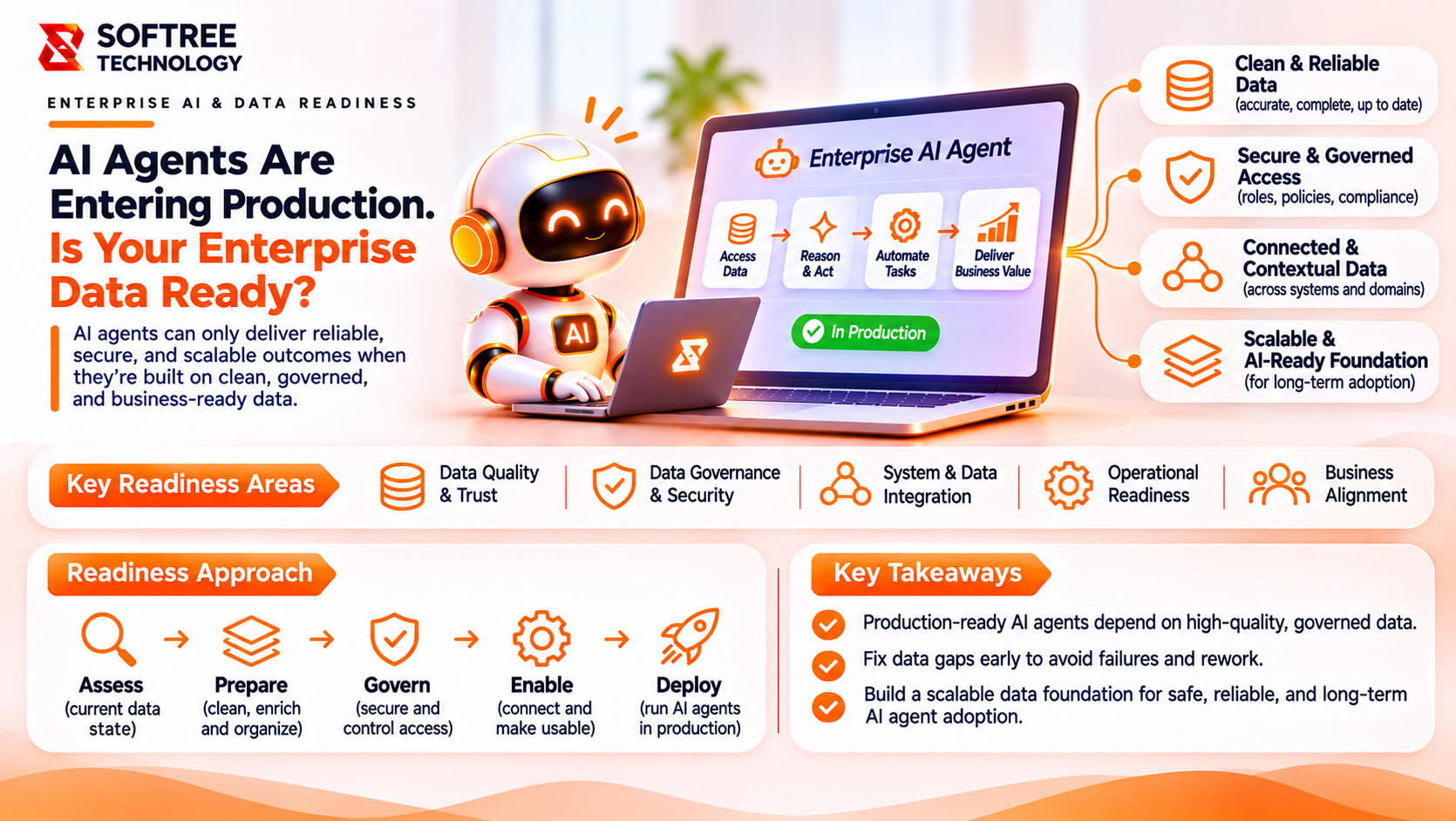
AI agents are moving from demonstrations into real business workflows. They answer employee questions, retrieve records, summarize documents, and interact with enterprise systems. However, their usefulness depends on the information they can access.
Enterprise knowledge is often distributed across SharePoint, databases, file repositories, and business applications. Outdated, fragmented, or poorly governed information can result in incomplete answers, unreliable responses, or unauthorized data exposure.
Data readiness is therefore essential before organizations scale AI agents. Microsoft Foundry provides agent-building capabilities, while Foundry IQ provides a knowledge layer for connecting agents to governed enterprise information.
Key Takeaways
- Production AI agents need reliable, current, and accessible enterprise data.
- Microsoft Foundry Agent Service supports building, deploying, and managing AI agents.
- Foundry IQ connects knowledge sources and retrieves relevant information with citations.
- RAG works well for documents, while authenticated APIs and MCP tools support live data and approved actions.
- Data permissions, ownership, quality, and monitoring should be considered from the beginning.
What Does Enterprise Data Readiness Mean?
Enterprise data readiness means making business information discoverable, current, permission-aware, and usable by AI agents.
AI models do not automatically know private company policies, customer records, or internal operational procedures. Agents need approved connections to reliable information sources.
Common data-readiness challenges include:
- Fragmented information across disconnected systems.
- Duplicate, outdated, or inconsistent documents.
- Missing data ownership and access policies.
- Retrieval processes that ignore user permissions.
These issues affect answer quality, security, auditability, and trust. Improving prompts alone cannot compensate for unreliable enterprise data.
How Microsoft Foundry Connects Agents to Enterprise Knowledge
Microsoft Foundry Agent Service supports agents that use tools and knowledge sources. Foundry IQ connects multiple information sources and retrieves relevant context with citations.
Depending on the source and configuration, retrieval can use keyword, vector, or hybrid search. Foundry IQ can plan queries, select relevant sources, and aggregate information.
Supported knowledge sources include:
- SharePoint
- Azure Blob Storage
- OneLake
The retrieval method should depend on the business task.
For example:
- Use RAG to retrieve company policies, reference documents, and internal procedures.
- Use authenticated APIs or MCP tools to access live transactional records or perform approved actions, such as checking a current order status.
This distinction helps organizations select the appropriate architecture for each data domain.
A Practical Enterprise Data Architecture
A typical Microsoft Foundry architecture can follow this workflow:
- A business user submits a request.
- A Microsoft Foundry agent interprets the request.
- Foundry IQ or approved retrieval tools identify relevant information.
- Enterprise sources such as SharePoint, OneLake, and Azure data services provide the required context.
- Permission-aware retrieval ensures the user can access the requested information.
- The agent generates a grounded response with supporting citations.
- Monitoring, evaluation, and governance processes help maintain reliability.
The architecture connects enterprise knowledge to AI agents while maintaining appropriate access boundaries.
Key Components of the Architecture
Microsoft Foundry Agent Service
Provides capabilities to build, deploy, and manage AI agents. It acts as the agent application and runtime.
Foundry IQ
Connects multiple knowledge sources and retrieves relevant information. It supports reusable knowledge access and grounded responses.
SharePoint, OneLake, and Azure Data Services
Provide approved enterprise information that agents can retrieve and use.
RAG and Agentic Retrieval
Find relevant content and return supporting evidence, helping agents generate more grounded and traceable responses.
APIs and MCP Tools
Connect agents to live business records and approved operational actions.
Four Things to Get Right Before Production
1. Identify Trusted Data Sources
Define authoritative information sources for each business domain. Assign data owners and identify obsolete or duplicate content.
2. Preserve User Permissions
Ensure retrieval respects user identity, source permissions, and sensitivity labels. Agents should not reveal information that users are not authorized to access.
3. Choose the Right Retrieval Method
Use RAG for documents and reference information. Use authenticated APIs or MCP tools for live transactional data and approved business actions.
4. Maintain Data Quality
Define refresh schedules, metadata standards, retention policies, and correction processes. Evaluate whether the retrieved information actually supports the generated answer.
Real-World Example: An Enterprise HR Knowledge Agent
Consider an organization building an HR knowledge agent connected to approved leave policies and procedures stored in SharePoint.
When an employee asks about leave eligibility, the agent retrieves relevant policy passages and responds with supporting citations.
Access controls help prevent the agent from exposing information the employee is not authorized to view.
However, if the employee asks for their current leave balance, static policy documents are not sufficient. The agent needs an authenticated connection to the HR system to retrieve live transactional information.
This example demonstrates why organizations need to combine document retrieval with secure application integrations.
When Should You Use Microsoft Foundry for Enterprise Data?
Microsoft Foundry is worth considering when AI agents need information from internal documents, structured business data, or multiple enterprise sources.
It is particularly relevant when organizations require:
- Reusable knowledge access across multiple agents.
- Permission-aware information retrieval.
- Grounded responses with citations.
- Integration with enterprise applications and data services.
- Governance and monitoring across AI workflows.
The right architecture depends on the type of information, how frequently it changes, and what actions the agent needs to perform.
Recommended Production Approach
Start with one clearly defined business use case and a limited set of trusted information sources.
Before expanding the implementation:
- Identify authoritative data sources and assign owners.
- Classify sensitive information.
- Choose RAG, APIs, or MCP tools for each data domain.
- Configure identity-aware permissions.
- Define indexing and refresh requirements.
- Evaluate answer relevance, citations, access boundaries, and data freshness.
- Monitor retrieval quality and agent behavior.
Testing these areas before expanding to additional business processes helps identify data and governance issues early.
What We Learned
Preparing enterprise data for AI agents requires more than connecting a model to documents or databases. Organizations need reliable information sources, clear ownership, appropriate permissions, and retrieval methods that match the business task.
For example, an HR agent can use RAG to answer questions about company leave policies, but it needs an authenticated HR-system connection to retrieve an employee's current leave balance.
The practical lesson is to treat data readiness as part of AI architecture from the beginning. Strong retrieval, permission management, data quality, and continuous evaluation are essential for building dependable production agents.
Next Steps
Preparing enterprise data for production AI requires the right combination of data integration, retrieval architecture, security, and governance.
Softree Technology helps businesses explore enterprise AI, intelligent agents, data integration, and automation. We support the design of practical AI workflows with security, governance, and operational requirements in mind.
Planning to prepare your enterprise data for AI agents? Connect with Softree Technology to explore an approach aligned with your business requirements.