Introduction
Modern enterprises generate enormous volumes of data from ERP systems, CRM platforms, cloud applications, financial systems, customer interactions, and operational processes. However, having large amounts of data does not automatically enable better business decisions. Organizations need the right strategy, technology, analytics capabilities, and processes to transform raw data into meaningful business insights.
Without a structured analytics strategy, enterprises can face limited visibility, delayed reporting, inaccurate forecasting, and inefficient decision-making. Data may remain distributed across different systems, making it difficult for business leaders to obtain a complete and reliable view of organizational performance.
Data Analytics Consulting Services help organizations address these challenges by developing strategies, processes, and technology solutions that turn enterprise data into actionable business intelligence. Through analytics, reporting, predictive insights, and data governance, organizations can improve operational performance and make more informed decisions.
Quick Answer: What Are Data Analytics Consulting Services?
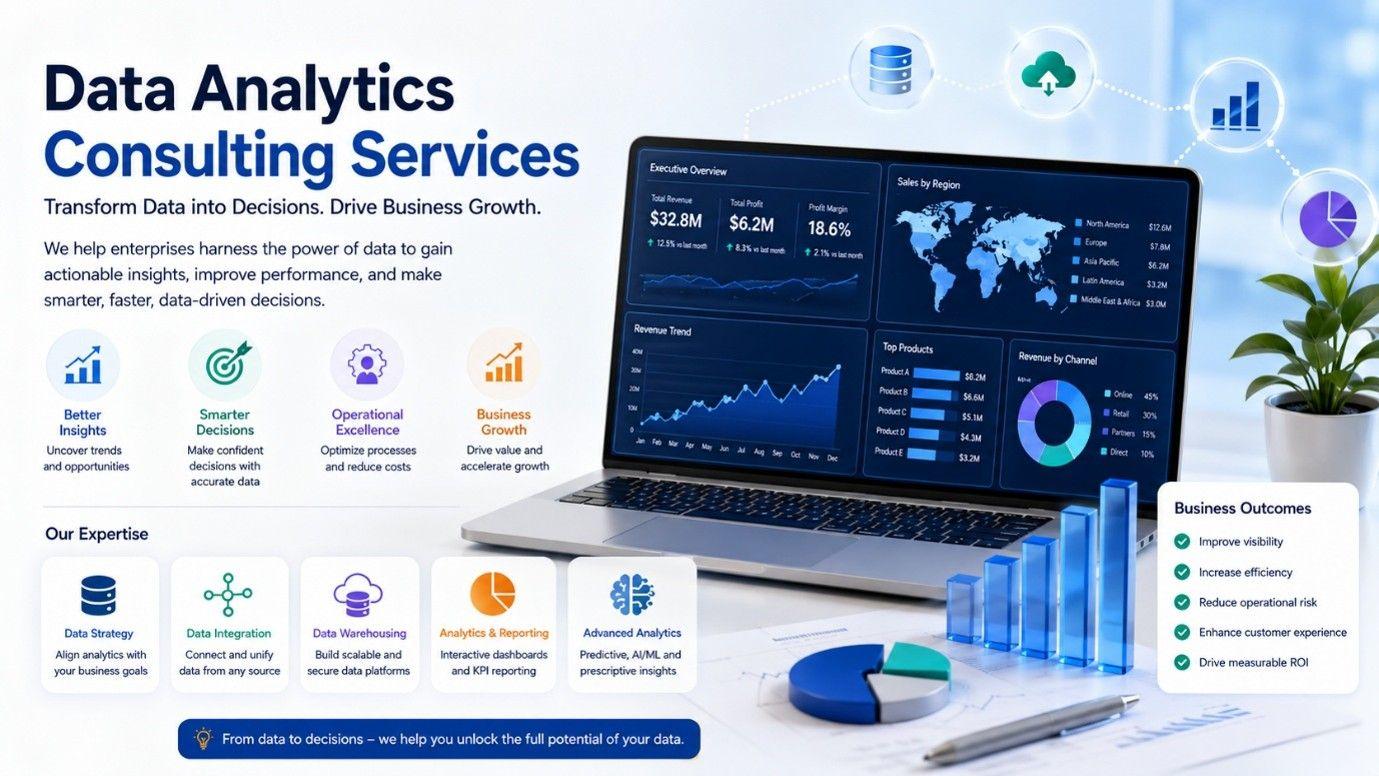
Data Analytics Consulting Services help organizations collect, integrate, analyze, and visualize data to support informed business decisions. These services can include data strategy development, data integration, data warehousing, business intelligence, dashboard development, KPI reporting, predictive analytics, data governance, and AI-powered analytics.
The primary value comes from creating a connected analytics environment where business leaders and teams can access reliable information, understand performance, identify trends, improve forecasting, and make decisions based on data rather than assumptions.
Table of Contents
- What Are Data Analytics Consulting Services?
- Why Are Data Analytics Consulting Services Important?
- How Do Data Analytics Consulting Services Work?
- Key Features and Components
- Benefits of Data Analytics Consulting Services
- Common Enterprise Use Cases
- Best Practices
- Common Mistakes to Avoid
- Traditional Reporting vs Analytics Consulting
- Key Takeaways
- Conclusion
What Are Data Analytics Consulting Services?
Data Analytics Consulting Services help organizations develop strategies, processes, and technology solutions that transform raw business data into actionable insights. Instead of treating data as isolated information stored across different applications, analytics consulting focuses on creating a structured approach for collecting, integrating, analyzing, and presenting data.
These services can cover Data Strategy Development, Data Integration, Data Warehousing, Business Intelligence, Dashboard Development, KPI Reporting, Predictive Analytics, Data Governance, and AI-Powered Analytics.
The objective is to help organizations create a data environment where decision-makers can access accurate and relevant information when they need it. This can support operational planning, financial management, customer analysis, forecasting, performance management, and strategic decision-making.
Why Are Data Analytics Consulting Services Important?
As organizations become increasingly data-driven, the ability to understand and use business information effectively becomes an important part of enterprise performance. Data analytics consulting helps organizations move from basic reporting toward deeper analysis and actionable business intelligence.
Business Impact
Data analytics can help organizations identify trends, understand operational performance, improve forecasting, and respond more effectively to changing business conditions. By bringing information together and presenting it through meaningful dashboards, reports, and analytical models, business leaders can gain a clearer understanding of what is happening across the organization.
Challenges Solved
Data Silos are a common challenge because business information often exists across multiple disconnected systems. Analytics consulting can help integrate these sources into a more unified data environment.
Limited Visibility can make it difficult for leaders to understand overall business performance. Centralized analytics and dashboards can provide a broader view of important business metrics.
Delayed Reporting can occur when teams depend heavily on manual reporting processes. Automated data integration and reporting can provide information more efficiently.
Poor Forecasting can limit an organization's ability to prepare for future opportunities and risks. Predictive analytics can use historical and current data to support more informed forecasting and planning.
How Do Data Analytics Consulting Services Work?
Assess Current Analytics Maturity
The process typically begins with an assessment of the organization's existing systems, data sources, reporting processes, and analytics capabilities. This helps identify current challenges and opportunities for improvement.
Consultants can evaluate how data is currently collected, stored, integrated, analyzed, and reported. The assessment can also help determine where data quality, reporting, or technology limitations are affecting decision-making.
Build a Unified Data Foundation
Once the current environment is understood, data from multiple business systems can be integrated into a centralized analytics platform. This can include information from ERP systems, CRM platforms, cloud applications, financial systems, and operational applications.
A unified data foundation helps reduce data silos and provides a more consistent source of information for reporting and analytics.
Develop Analytics and Reporting Solutions
With the data foundation in place, organizations can develop dashboards, reports, KPI scorecards, and predictive models that support business requirements.
These solutions can provide executives and business teams with relevant information about organizational performance, operational efficiency, financial results, customer behavior, and future trends.
Analytics Flow
Data Sources → Data Integration → Data Warehouse → Analytics Platform → Dashboards & Reports → Business Decisions
This approach creates a structured path from raw enterprise data to actionable business insights.
Key Features and Components
Data Strategy Consulting
Data strategy consulting aligns analytics initiatives with business goals and objectives. It helps organizations determine what data is required, how it should be managed, and how analytics can support business priorities.
Business Intelligence and Reporting
Business Intelligence solutions transform enterprise data into dashboards, KPI scorecards, executive reports, and other analytical outputs. These tools help business users understand performance and identify important trends.
Data Integration
Data integration connects information from ERP systems, CRM platforms, cloud applications, databases, and operational systems. This helps organizations create a more connected view of enterprise information.
Data Warehousing
Data warehousing provides a centralized environment for storing and organizing data for analytics. A well-designed data warehouse can support scalable reporting, historical analysis, and enterprise-wide business intelligence.
Predictive Analytics
Predictive analytics uses historical and available business data to identify patterns and support forecasting. Organizations can use predictive insights to better understand potential trends, opportunities, and risks.
Data Visualization
Data visualization converts complex datasets into charts, dashboards, and other visual formats that make information easier to understand. Effective visualization helps business users quickly identify patterns and important changes.
Data Governance
Data governance supports data quality, security, consistency, and compliance. It helps establish appropriate standards for how enterprise data is managed and used across analytics environments.
Benefits of Data Analytics Consulting Services
Faster Decision-Making
Access to accurate and relevant information can help business leaders make decisions faster. Instead of waiting for manually prepared reports, teams can use centralized dashboards and analytics to understand current performance.
Better Forecasting
Predictive analytics can help organizations identify trends and anticipate potential business outcomes. This can support planning, budgeting, demand forecasting, and risk management.
Improved Operational Efficiency
Analytics can help identify process bottlenecks, inefficiencies, and areas for optimization. Organizations can use these insights to improve operations and allocate resources more effectively.
Increased Revenue Growth
Analyzing sales performance, customer behavior, and market trends can help organizations identify opportunities to improve sales and customer engagement.
Enhanced Business Visibility
Enterprise dashboards and reporting solutions can provide executives with a broader view of organizational performance. This improves transparency and helps different teams work with a more consistent understanding of business metrics.
Common Enterprise Use Cases
Financial Analytics
Financial analytics helps organizations monitor revenue, expenses, profitability, budget performance, and other financial indicators. By consolidating financial information and presenting it through dashboards and reports, organizations can improve financial visibility and planning.
Sales and Customer Analytics
Sales and customer analytics can be used to analyze sales performance, customer behavior, market trends, and customer retention. These insights can help organizations understand customers more effectively and identify opportunities for revenue growth and improved customer satisfaction.
Supply Chain Analytics
Supply chain analytics can provide visibility into inventory, procurement, logistics, and demand forecasting. Organizations can use these insights to identify operational risks, improve planning, and increase supply chain efficiency.
Manufacturing Analytics
Manufacturing analytics can support production optimization, predictive maintenance, and quality monitoring. By analyzing operational data, organizations can identify potential inefficiencies and improve productivity while reducing operational risks.
Best Practices
Establish Clear Business Objectives
Analytics initiatives should focus on measurable business outcomes. Before selecting technologies or developing dashboards, organizations should define the business questions they need to answer and the decisions the analytics solution needs to support.
Implement Strong Data Governance
Reliable analytics depends on reliable data. Organizations should establish appropriate processes for data quality, security, consistency, ownership, and compliance.
Prioritize High-Impact KPIs
Organizations should focus on KPIs that directly influence business performance. Too many metrics can make dashboards difficult to use, while carefully selected KPIs can provide clearer insights.
Enable Self-Service Analytics
Self-service analytics can empower business users to explore information and answer questions while maintaining appropriate governance and security controls.
Continuously Improve Analytics Models
Analytics environments should evolve as business requirements change. Dashboards, KPIs, forecasting models, and data sources should be regularly reviewed and improved to maintain their business value.
Common Mistakes to Avoid
Ignoring Data Quality
Poor-quality or inconsistent data can produce unreliable insights. Organizations should address data quality issues before depending heavily on analytics outputs.
Focusing Only on Technology
Analytics should solve real business problems rather than simply generate reports. Technology selection should follow business requirements and desired outcomes.
Lack of Executive Sponsorship
Leadership support is important for analytics adoption and organizational change. Executive involvement can help align analytics initiatives with strategic business priorities.
Overcomplicated Dashboards
Dashboards containing excessive information can make decision-making more difficult. Analytics should focus on presenting the most relevant information clearly and efficiently.
Neglecting User Training
Even a technically strong analytics solution can provide limited value if employees do not understand how to use it. Training and adoption should therefore be part of the implementation strategy.
Traditional Reporting vs Analytics Consulting
Traditional reporting often focuses on presenting historical information through manually prepared reports and spreadsheets. While this can provide useful information, it may not provide the speed, integration, or predictive capabilities required by modern enterprises.
Data Analytics Consulting takes a broader approach by combining data integration, centralized data platforms, business intelligence, visualization, predictive analytics, and governance. Instead of simply reporting what happened, organizations can use analytics to understand current performance, identify patterns, and support future planning.
Key Takeaways
Data Analytics Consulting Services help organizations transform raw enterprise data into meaningful business insights.
A structured analytics strategy can improve visibility across business operations, support faster decision-making, and improve forecasting and planning.
Data integration and centralized analytics platforms help reduce data silos, while Business Intelligence and visualization solutions make complex information easier to understand.
Predictive analytics and AI-powered insights can provide additional support for identifying trends, opportunities, and potential risks.
Strong data governance, clear business objectives, relevant KPIs, and continuous improvement are essential for creating a successful enterprise analytics environment.
Conclusion
Data Analytics Consulting Services can help organizations unlock the value of their data through business intelligence, enterprise reporting, predictive analytics, data visualization, and structured data strategies. By bringing data from different business systems together and transforming it into meaningful insights, organizations can improve visibility, optimize operations, and make more informed business decisions.
The goal is not simply to collect more data or create more dashboards. It is to build an analytics environment that connects business objectives with trusted data and actionable insights, helping leaders and teams understand performance and respond more effectively to business opportunities and challenges.
If your organization is looking to improve business visibility, strengthen forecasting, modernize analytics, or enable data-driven decision-making, Softree Technology can help design and implement Data Analytics solutions aligned with your business and technology requirements.
Learn more about Data Analytics Consulting Services and enterprise analytics solutions from Softree Technology.